
Insurance and employer benefits
Lodging reimbursement for Cleveland Clinic stays
Some health plans and employers help pay for lodging when you travel to Cleveland Clinic for care. Most do it as a reimbursement: you pay for the stay, then send the plan your receipts. Whether you qualify, and how much comes back, depends on your plan.
At a glance
What plans commonly set
Three numbers to check in your plan
Travel and lodging benefits are most common for transplants and for care at a plan's designated centers of excellence. Some employer programs, Medicare Advantage plans and state Medicaid programs offer them too. Each plan sets its own terms.
Distance from home
Many plans pay only when you live this far or farther from the hospital.
Nightly limit, per person
Often $100 for the patient and one companion. Some plans set a higher limit.
Total limit
Often per transplant or per lifetime. A long stay can reach it before treatment ends.
Examples from published plan documents. Your plan's numbers may differ. Last reviewed November 2026. The longer version: will insurance pay for lodging during treatment, and the IRS $50-a-night rule for HSA, FSA and taxes.


The process
How reimbursement usually works
Ask your plan first
Confirm the benefit and its limits. Long stays often need approval before you check in.
Book and pay
You pay for your lodging when you book. At Nearwell, that is by card.
Keep every receipt
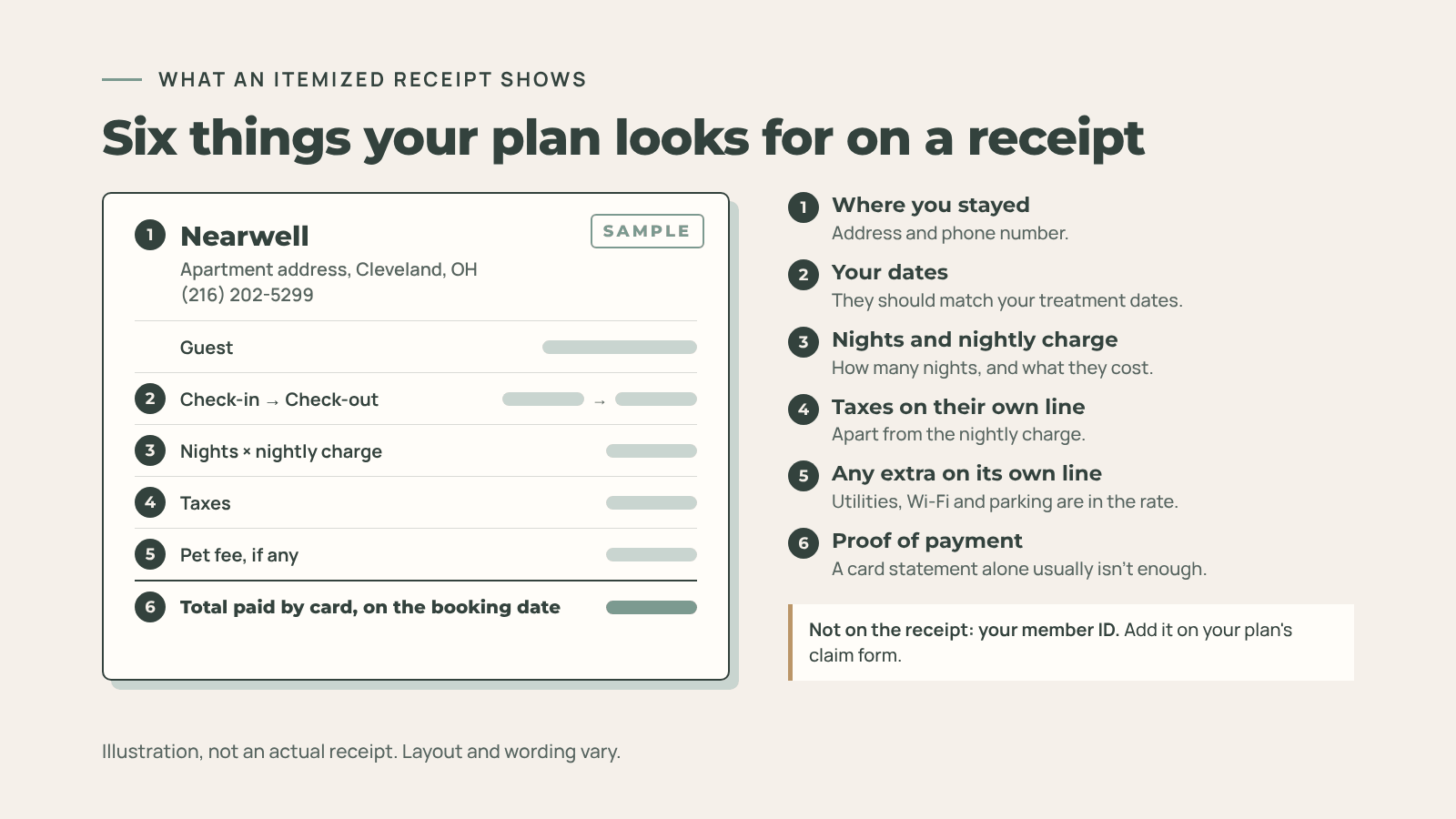
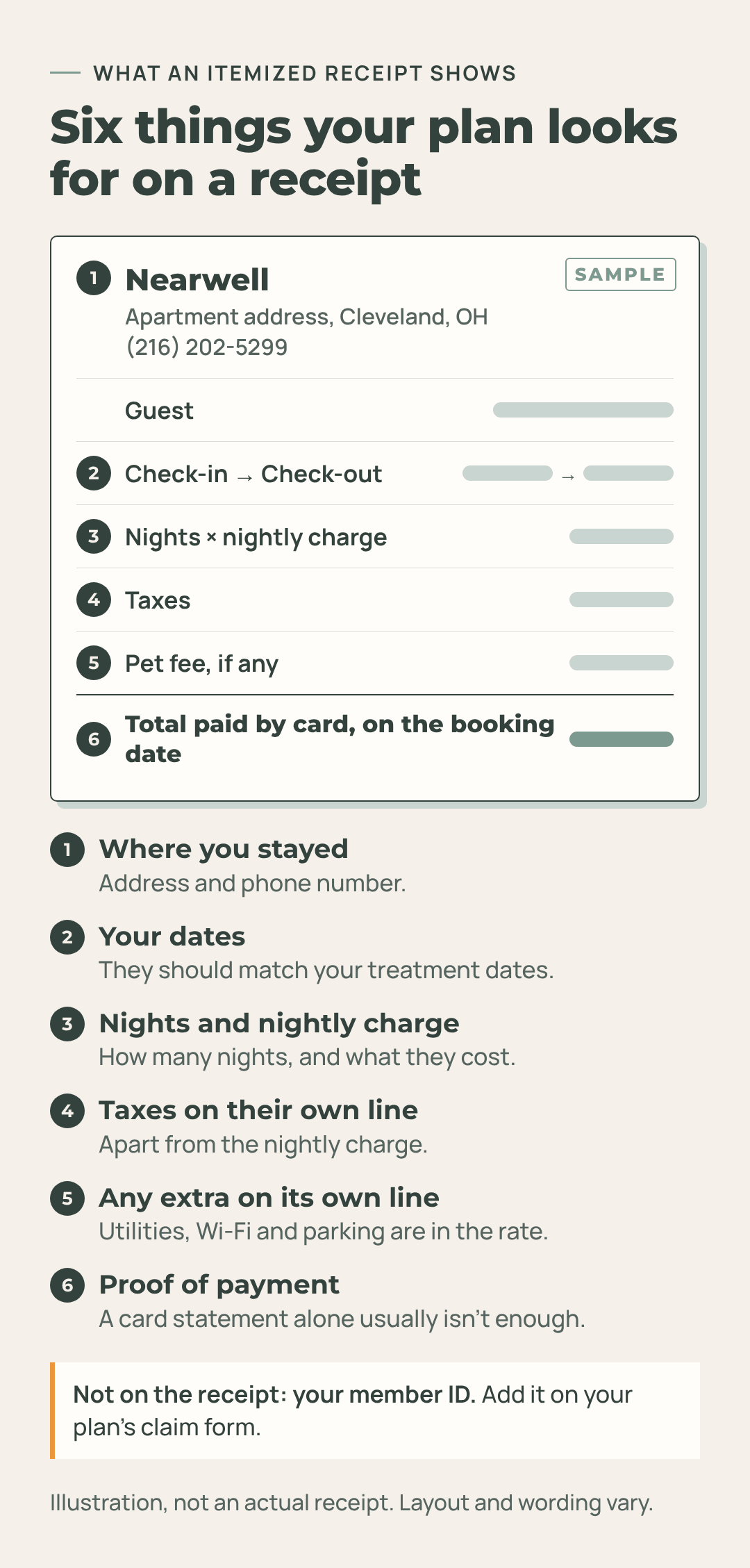
Plans want itemized receipts. A card statement on its own is usually not accepted.
File before the deadline
The plan pays you back up to its nightly and total limits.
If your employer sends you to Cleveland Clinic through a program, ask whether lodging has to be booked by the program. Some programs only pay for lodging they arrange themselves.


Paperwork
What your plan asks for, and what we provide
Some plans won't reimburse utilities billed apart from the rent. One rate that includes them keeps your claim simple. Your plan decides whether a pet fee counts as lodging.
Before you book
Questions to ask your plan
Call the member services number on your insurance card, or your employer's benefits line. Ask for the answers in writing when you can, and note who you spoke with and when.
- 01Does my plan have a travel and lodging benefit for this treatment at Cleveland Clinic?
- 02How far from the hospital do I need to live to qualify?
- 03What is the nightly limit, and does it include a caregiver?
- 04Is there a total limit for this treatment, or for my lifetime?
- 05Do I need approval before a long stay? Does an apartment qualify the same way a hotel does?
- 06Does lodging have to be booked through the plan or through my employer's program?
- 07Which receipts do you need, and how long do I have to file?
For care teams
For care coordinators, social workers and benefits navigators
If you help patients plan treatment in Cleveland, this is how a stay with us works for the families you refer.
Paid by card, with a receipt for the plan
Reservations are paid by card at booking. We don't invoice insurers or employers. Families get an itemized receipt for their plan.
Help booking by phone
If booking online is hard for a family, our team can complete the reservation with them by phone.
Weeks or months, close to campus
Stays can run for weeks or months, and extensions go through our team. Apartments are a short drive from main campus, and some buildings are across the street.

Longer stays
Set up for stays of weeks or months
Many transplant programs ask patients to stay near the hospital for weeks or months after surgery, often with a caregiver close by. Some of our buildings are across the street from main campus, and others are 2 to 5 minutes away by car.
Kitchen and laundry in the unit
Cook and wash clothes without leaving the apartment.
Room for a caregiver
Studios through four-bedroom apartments, so a caregiver or family can stay with you.
Extensions through our team
Message us and we handle it. We try to keep you in the same apartment, and when it's booked we find you a path into another one. Tell us as early as you can.
Plan your stay with the paperwork in mind
Check dates online, or tell our team what your plan requires and we'll help you plan around it.
Questions about insurance and lodging
Quick answers to what guests ask about paying for a stay through a health plan or employer.
Some plans reimburse lodging, up to a limit, when you travel for care, most often for transplants and for care at a designated center of excellence. Whether yours does depends on the plan, the treatment and how far you live from Cleveland Clinic. We can't tell you what your plan covers, so ask your plan before you book.
It depends on the plan. Optum's travel and lodging guidelines, for example, count rented apartments as lodging. Other plans limit the benefit to hotels or to lodging their own program books. Ask your plan how it treats an apartment before you book.
No. Reservations are paid by card at booking. We give you an itemized receipt so you can file for reimbursement with your plan.
It can qualify, within IRS limits. Lodging away from home counts as a medical expense, up to $50 per night per person, when it is primarily for and essential to medical care at a hospital or similar facility. HSA and FSA administrators apply that rule and may ask for a letter of medical necessity and a detailed receipt. Check with your account administrator first.
It can be. IRS Publication 502 lets you count lodging of up to $50 per night per person, and lodging for a companion traveling with the patient counts too. Meals don't. The deduction only helps if you itemize and your medical expenses are more than 7.5% of your adjusted gross income. A tax professional can tell you whether it applies to you.
No. There is no minimum stay, and stays can extend into months.
Message our team as soon as you know. We try to keep you in the same apartment, and when it's booked we find you a path into another one. Last-minute notice in a fully booked week is the one case that gets hard.